
In the first part of this series, we explored the hidden costs of ignoring firmware integrity within SI-7 compliance programs; from unmonitored BIOS modifications and persistent rootkits to audit findings stemming from incomplete integrity controls. BIOS firmware sits at the foundation of every system, and its compromise can silently undermine even the most advanced endpoint and network defenses.
This follow-up focuses on how organizations can integrate continuous firmware monitoring into their SI-7 programs — not as a burdensome add-on, but as an operationally efficient component of a mature integrity management strategy.
Continuous monitoring isn’t just a compliance checkbox; it’s the mechanism that enables security teams to detect deviations in real time, demonstrate control effectiveness to auditors, and maintain operational trust across critical systems. For enterprises and government agencies facing increasingly stringent oversight, the ability to continuously verify BIOS firmware integrity is now a defining indicator of system resilience.
The remainder of this article will outline how to operationalize BIOS firmware integrity monitoring in alignment with SI-7 objectives — from building accurate baselines to automating evidence collection and integrating results into broader security workflows.
Continuous Monitoring as a Compliance Strategy
Continuous monitoring is central to SI-7. It ensures that system integrity is not verified once during deployment, but constantly throughout the system’s lifecycle. The NIST guidance emphasizes ongoing awareness of system security, risk posture, and integrity state — a principle that extends directly to firmware.
For SI-7, continuous monitoring achieves three core objectives:
- Real-time detection: Identifying unauthorized firmware changes or deviations as they occur.
- Audit readiness: Maintaining continuous evidence of system integrity, simplifying compliance validation and reporting.
- Anomaly identification: Correlating low-level deviations with higher-level behaviors, such as unusual boot processes or failed Secure Boot validations.
Technically, achieving this requires deeper integration into existing monitoring architectures. Firmware-level telemetry — such as signed firmware hashes, OEM integrity events, and Secure Boot logs — must be collected and correlated with other security data sources. Centralized logging via SIEM or XDR platforms enables SOC analysts to respond to anomalies quickly, supported by well-defined alerting thresholds and escalation workflows.
Continuous monitoring bridges the gap between compliance intent and operational execution. It transforms SI-7 from a static control into a living process, continuously validating that systems remain in a trusted, compliant state, even in dynamic or hostile environments.
For Government agencies and enterprises, this shift reduces audit fatigue, strengthens incident response, and provides clear, defensible evidence of system integrity.
Operationalizing Firmware Integrity Checks
Integrating firmware monitoring into existing operations doesn’t require reinventing the wheel. Instead, it simply requires extending existing SI-7 processes downward into the UEFI BIOS firmware layer.
Below is a step-by-step approach to doing so efficiently and effectively:
Inventory Critical Assets
Start by cataloging all assets with firmware components that impact system trust. This includes servers, laptops, workstations, IoT, and edge devices. Record firmware versions, OEM-specific configurations, and update mechanisms. For agencies and defense contractors, this inventory should align with authoritative sources such as CMDBs or asset management systems to ensure traceability.
Establish Baseline Measurements
Next, establish known-good baselines for firmware integrity. This typically involves generating cryptographic hashes of BIOS/UEFI firmware images and verifying OEM-provided digital signatures. The baseline acts as a “gold standard” against which future measurements are compared.
Baselining should also consider firmware configuration states — for instance, ensuring Secure Boot is enabled, debug ports are disabled, and default credentials are removed. Each baseline should be version-controlled and time-stamped to support future audits.
Implement Automated Monitoring
Manual checks are insufficient for continuous compliance. Automated tools should periodically or continuously scan for firmware deviations, unauthorized updates, or mismatched hashes. Integration with existing telemetry — such as TPM attestation or OEM integrity logs — enhances coverage.
Advanced monitoring systems can detect not just version drift, but also integrity anomalies caused by tampering or corrupted firmware modules. Continuous collection and validation of this telemetry reduces both mean time to detection (MTTD) and mean time to resolution (MTTR).
Integrate with SOC Workflows
Detected deviations should feed directly into SOC alerting pipelines. Firmware integrity events must be triaged alongside traditional endpoint and network alerts, ensuring unified visibility. Correlation rules within SIEMs should flag patterns such as multiple firmware changes within a short period or failed signature validations.
Balance Frequency and Operational Impact
While continuous polling offers the strongest assurance, it can impact performance or system availability. Many organizations adopt risk-based scheduling, increasing frequency for mission-critical systems while applying less frequent checks to lower-impact assets.
When implemented thoughtfully, firmware monitoring strengthens both compliance and operational resilience without overwhelming security or infrastructure teams.
Reporting and Audit Readiness
One of the biggest challenges organizations face in SI-7 compliance is demonstrating verifiable evidence of integrity monitoring. Firmware introduces complexity — its data sources are fragmented, and traditional monitoring tools rarely provide native support.
Effective continuous monitoring simplifies this challenge by producing structured, audit-ready evidence. The following artifacts typically satisfy SI-7 verification requirements:
- Change logs documenting firmware updates, version changes, or failed validations.
- Anomaly reports highlighting unauthorized modifications or deviations from baselines.
- Remediation records showing corrective actions taken and retesting results.
Automated reporting capabilities enable organizations to generate compliance evidence on demand. Instead of manually consolidating spreadsheets and screenshots, security teams can produce timestamped integrity verification reports that auditors can validate directly.
For example, a monthly SI-7 compliance report might include:
- The percentage of assets verified against baseline.
- Firmware versions and their cryptographic verification status.
- Details of any deviations detected and remediated.
Automation also ensures consistency — every check, alert, and response is logged with precision, improving the defensibility of audit submissions.
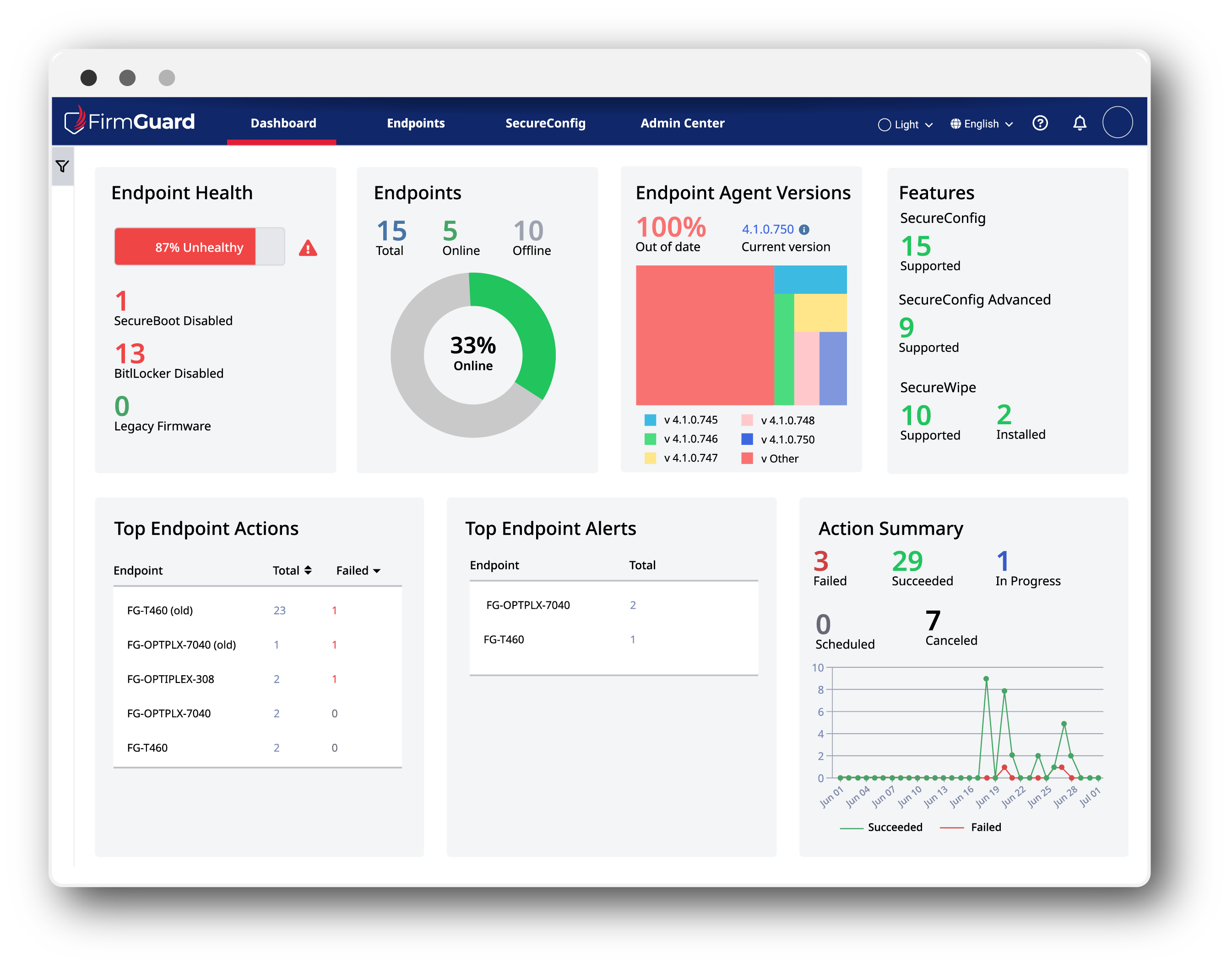
FirmGuard helps operationalize this by aggregating firmware telemetry, correlating events, and generating compliance-ready dashboards. For organizations seeking to demonstrate continuous integrity assurance to regulators or certification bodies, automation dramatically reduces audit overhead while improving accuracy and confidence.
Integrating BIOS Firmware into Broader Security Programs
Firmware monitoring should not exist in isolation. Its greatest value emerges when integrated with broader security and compliance ecosystems.
By linking firmware telemetry to endpoint detection, vulnerability management, and threat intelligence programs, organizations gain a holistic view of system health. A firmware deviation detected by integrity checks might correlate with suspicious network traffic, anomalous authentication attempts, or privilege escalation — insights that would otherwise go unnoticed.
Integrating firmware monitoring enhances several key functions:
- Threat Detection: Firmware changes outside maintenance windows can indicate early-stage compromise or supply chain tampering.
- Vulnerability Management: Firmware version data feeds directly into vulnerability assessments, highlighting unpatched components.
- Incident Response: When integrated into SOC workflows, firmware alerts help analysts pinpoint persistent attack vectors.
- Compliance Alignment: Continuous validation ensures that SI-7, CM-6 (Configuration Settings), and RA-5 (Vulnerability Scanning) remain synchronized.
Strategically, UEFI BIOS firmware integrity serves as the root of trust for every other control. Without it, higher-level monitoring — from OS to applications — may rest on compromised foundations. Embedding firmware verification into existing programs not only strengthens compliance but also elevates overall resilience.
As regulatory frameworks continue to evolve, integrating firmware into enterprise security architectures ensures organizations remain prepared for future mandates and emerging threats. Continuous firmware monitoring is not a niche control; it’s a cornerstone of zero-trust architecture and system assurance.
You Need to Act Now
Firmware integrity is no longer optional in SI-7 compliance. Continuous monitoring transforms it from a static, audit-time requirement into a living, automated safeguard. By continuously validating firmware integrity, organizations gain real-time assurance that systems remain in a trusted state — an essential foundation for security, compliance, and mission continuity.
Security leaders should evaluate their existing SI-7 programs for firmware visibility gaps and begin integrating continuous monitoring workflows into SOC and compliance processes.
For those seeking practical guidance, standards like NIST SP 800-137 (Information Security Continuous Monitoring) and the NIST Cybersecurity Framework offer solid reference points. Tools and platforms, including those purpose-built for firmware visibility such as FirmGuard, can streamline this transition from periodic checks to real-time integrity assurance.
The result: stronger compliance, faster detection, and a more trustworthy operational foundation.